

We all do it. Before a talk, a breakup, a purchase, or a hard conversation, we try to guess how we will feel later. We picture relief, shame, joy, regret, pride. Then we choose based on that picture.
This is emotional forecasting. It is the mind’s attempt to predict future feelings and use them as a guide in the present. Sometimes it helps. Sometimes it bends our choices in ways we do not notice.
Emotional forecasting is the process of predicting how we will feel after a future event or decision.
In our experience, many people think decisions are mostly rational, yet daily life shows something else. We do not only ask, “What will happen?” We also ask, “How will I feel if this happens?” That second question often carries more weight.
We see this in simple moments. A person delays a medical check because they expect fear. Another accepts a job because they imagine pride, then later feels drained. Someone stays silent in a conflict to avoid discomfort now, only to feel heavier later.
We choose with tomorrow’s feelings in mind.
Why anticipation has so much power
Anticipation is not neutral. It carries memory, fear, desire, and past wounds. When we imagine the future, we do not do so from a clean space. We do it from who we are now.
That is why two people can face the same event and forecast very different emotions. One sees a public speech and imagines growth. Another sees the same stage and predicts humiliation. The event has not happened, but a full emotional script is already active.
We do not react only to events. We react to the meaning we expect those events to have.
This expected meaning shapes many areas of life:
Relationships, when we expect rejection, closeness, or guilt
Work, when we chase recognition or avoid failure
Health, when we imagine relief after action or discomfort before it
Money, when we predict safety, regret, or excitement
When our inner picture is distorted, our decision can become distorted too.
Where emotional forecasting goes wrong
We often overestimate intensity and duration. We think success will satisfy us for much longer than it does. We think embarrassment will destroy us for days, when in truth it fades by evening. We imagine one outcome as total relief, and another as total disaster. Real life is rarely that pure.
There is also selective attention. We focus on one emotional detail and ignore the full experience. We think, “If I say no, I will feel guilty.” Maybe. But we may also feel calm, clear, and more honest. If we focus only on guilt, we may betray ourselves.
Another error comes from old emotional patterns. If our history taught us that conflict leads to abandonment, we may forecast pain in any honest disagreement. Then we avoid truth, not because truth is bad, but because our anticipation is tied to older fear.
Short sentence. Big effect.
Forecasting is not only about the future. It is also about the past living inside the future.
What research shows about decisions
Recent findings help us see how these predictions shape behavior. In a study from the University of Texas at Dallas, errors in predicted emotional valence were linked to punitive choices in the Ultimatum Game. In simple terms, when what people expected to feel did not match what they later felt, those errors were tied to how harshly they chose to act. The size of these errors also changed across adulthood.
We find this very human. When our emotional forecast is off, our choice can harden. We may punish, withdraw, or overreact because we trusted a false inner prediction.
Another broad multinational study across 74 countries found that higher self-reported positive emotion was associated with more patience and with willingness to take favorable risks. That does not mean feeling good makes every risk wise. It means our emotional state can shape whether we wait, rush, hold back, or move forward.
Anticipated feeling does not stay inside the mind. It changes behavior.

How it affects health and self-control
Forecasting also shapes habits. If we expect exercise to feel awful, we resist it. If we expect a hard conversation to bring some relief after the first discomfort, we may finally have it. What we think we will feel can support action or block it.
A meta-analysis of 38 experimental health-behavior studies, covering about 72,020 participants, found that interventions aimed at affective forecasting had immediate effects on behavior change, anticipated regret, and behavioral intention. We read this as a clear sign that when people rethink future feeling in a more realistic way, choices can shift.
This matters because many poor decisions are not made from lack of knowledge. They come from emotional anticipation that feels more convincing than facts.
We may know that setting a boundary is healthy. We still avoid it because we forecast guilt. We may know that saving money helps. We still spend because we forecast quick comfort. Information is present, but anticipation wins.
How to forecast more honestly
We cannot remove anticipation, nor should we. It is part of human guidance. But we can make it more grounded.
In our view, a better forecast begins when we stop treating one emotion as the whole truth. Instead of asking only, “How bad will this feel?” we can ask better questions.
For example:
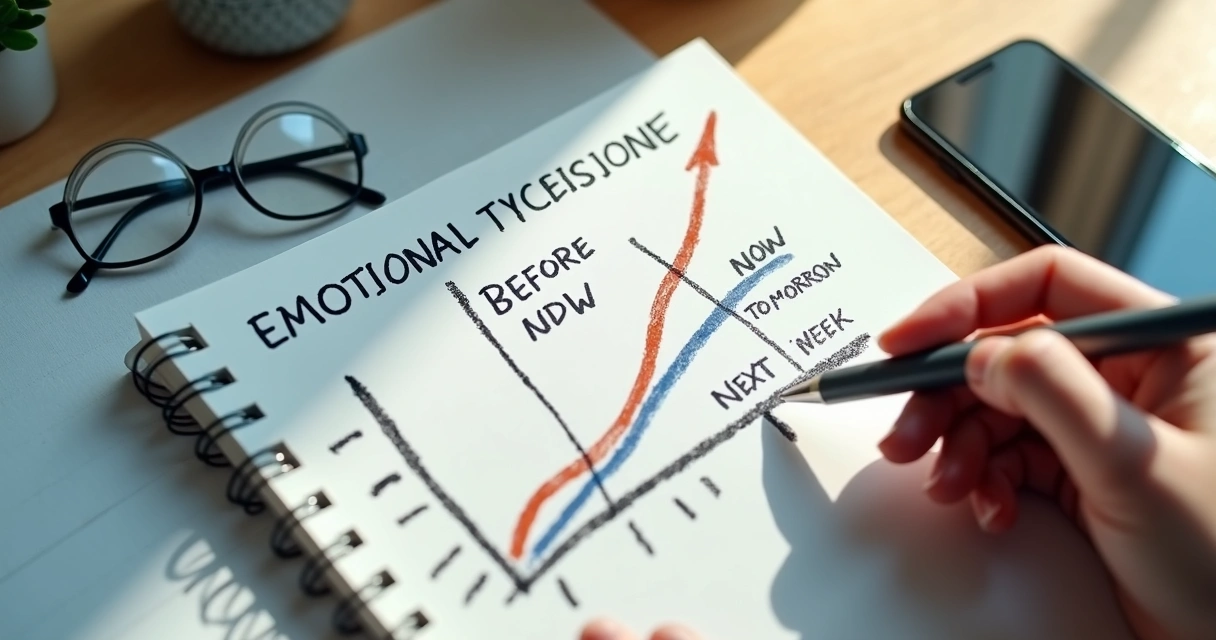
What will I likely feel in the first hour?
What will I likely feel one week later?
Am I predicting from the present wound or from the actual situation?
Which feeling am I exaggerating and which one am I leaving out?
These questions create inner space. They slow the automatic script.
It also helps to separate immediate discomfort from deeper alignment. Many sound choices do not feel pleasant at first. Telling the truth, ending a false agreement, beginning treatment, saying no, or staying with grief may all hurt in the short term. Yet they can create steadier peace later.
A mature decision is not always the one that promises fast relief, but the one that respects the whole emotional timeline.
Short relief can hide long regret.
Conclusion
Emotional forecasting shapes far more than mood. It shapes action, delay, courage, avoidance, patience, and reaction. We do not merely choose between external options. We choose between inner futures we imagine in advance.
When those inner forecasts are narrow, old, or inflated, our decisions lose clarity. When they become more honest, more layered, and less ruled by fear, our choices gain coherence. We still feel uncertainty. Of course. But we stop obeying every prediction as if it were fact.
That shift changes a lot. Not because it gives us perfect control, but because it helps us relate to ourselves with more awareness and less automatic behavior.
Frequently asked questions
What is emotional forecasting?
Emotional forecasting is the mental process of predicting how we will feel after a future event, choice, or outcome. We use these predictions to guide present decisions, often without noticing how much influence they have.
How does anticipation affect decisions?
Anticipation affects decisions by making us move toward expected pleasure and away from expected pain. If we expect relief, pride, or peace, we may act. If we expect shame, guilt, or fear, we may delay, avoid, or choose too quickly.
Can emotional forecasting improve choices?
Yes, it can improve choices when it becomes more realistic. If we consider both short-term and long-term feelings, we are less likely to act from impulse or avoidance. Better forecasting supports decisions that fit our values, not only our immediate comfort.
Why do people misjudge future feelings?
People misjudge future feelings because they often overestimate intensity, ignore how emotions change with time, and project old emotional patterns onto new situations. They may also focus on one expected feeling while missing the wider emotional picture.
How to get better at emotional forecasting?
We can get better by slowing down and asking more precise questions about timing, context, and hidden fears. It helps to ask what we will feel now, later today, and weeks from now. It also helps to notice when our forecast comes from past pain rather than the present reality.