


We all try to feel better when stress rises. We reach for a warm drink, a long shower, a walk, a screen, a snack, or a task that keeps the mind busy. On the surface, many of these acts look alike. They all bring relief. But not all relief works in the same way.
Self-soothing helps us stay in contact with our inner state while calming it.
Self-distracting pulls our attention away from discomfort, often without helping us process it.
This gap matters. If we confuse one for the other, we may think we are caring for ourselves when we are only postponing contact with what hurts.
We have seen this in common moments of daily life. A person feels rejected after a hard conversation. Instead of pausing, breathing, and naming the pain, they open three apps, answer random messages, and watch videos for an hour. Their body gets quieter for a while. Yet the inner charge stays active. Later, it returns with the same force, or more.
That is the difference in practice. Self-soothing calms without cutting the bond with experience. Self-distracting interrupts awareness to escape discomfort.
Why the confusion happens
The confusion is easy to understand. Both strategies can lower distress in the short term. Both can look harmless. Both can even be useful in certain moments. The problem is not relief itself. The problem is the route we take to get it.
Human beings start learning ways to regulate distress very early. In fact, self-comforting habits described by the American Academy of Pediatrics begin in infancy as part of development. This tells us something simple and deep: the need to soothe is natural. We are built to seek regulation.
Still, as we grow, our methods become more complex. Some support awareness. Others help us avoid it. And many of us were never taught how to tell the difference.
Relief is not always repair.
What self-soothing really does
Self-soothing is an active form of inner care. We do not deny the emotion. We do not run from it. We create conditions so the nervous system can settle enough for us to remain present.
This can be very simple. We might wrap ourselves in a blanket after a painful day. We might breathe slowly with one hand on the chest. We might sit in silence and say, “This hurt me.” We might cry without rushing to stop.
Healthy self-soothing often includes a few traits:
- It lowers activation in the body.
- It keeps us aware of what we feel.
- It does not punish or numb us.
- It supports later reflection or honest action.
In our view, self-soothing has a regulating function, not an erasing one. It says, “I can stay with this, and I can care for myself while I stay.”
That is why self-soothing often has a gentle quality. It is not dramatic. It does not demand intensity. It creates enough safety for emotion to move instead of freeze.

What self-distracting tends to do
Self-distracting is not always bad. Sometimes it is the right move. If our distress is too high, a temporary shift of attention can stop us from spiraling. A repetitive game, folding clothes, or watching a light show may help us regain enough stability to function.
But trouble starts when distraction becomes our main emotional language.
Self-distracting gives distance from feeling, but it does not always give understanding.
We can spot this when the activity has one hidden goal: “I do not want to feel this.” At that point, the action may reduce awareness instead of support regulation. We are no longer caring for the emotion. We are stepping around it.
Common forms of self-distraction include:
- Scrolling for long periods without clear purpose
- Overeating to mute tension
- Working nonstop to avoid sadness
- Filling every quiet moment with noise
We may tell ourselves we are resting. Sometimes we are. Sometimes we are hiding. The honest answer depends on whether we can still sense what is happening inside us.
How to tell the difference in real time
When we are upset, subtle cues help us tell whether we are soothing or distracting. The body usually knows before the mind admits it.
We can ask:
- Am I calming down while staying aware of what I feel?
- Do I feel more settled, or just less conscious?
- After this, will I be more able to face the issue?
- Am I choosing this freely, or reacting on autopilot?
Here is a simple contrast. If we take a slow walk after conflict and let our breathing settle while we reflect gently, that is likely self-soothing. If we walk while forcing ourselves to think about anything except the conflict, the same action shifts toward distraction.
The act alone does not define the category. The inner posture does.
Intent changes the meaning of the act.
When distraction is useful, and when it becomes avoidance
We do not need to treat distraction as an enemy. In acute stress, it can protect us. A brief pause from emotional overload may stop impulsive choices. It may create a buffer until we are ready to come back.
What makes distraction risky is not its existence, but its permanence.
If we always postpone contact with pain, pain does not disappear. It often settles into the body, leaks into relationships, and shapes our reactions without our consent. We become irritable, detached, or exhausted, and we do not know why.
We think a helpful sequence often looks like this:
- Notice the distress.
- Lower the intensity with safe regulation.
- Return to the feeling with honesty.
- Respond in a more conscious way.
In this sequence, even distraction can have a place. But it is a bridge, not a home.
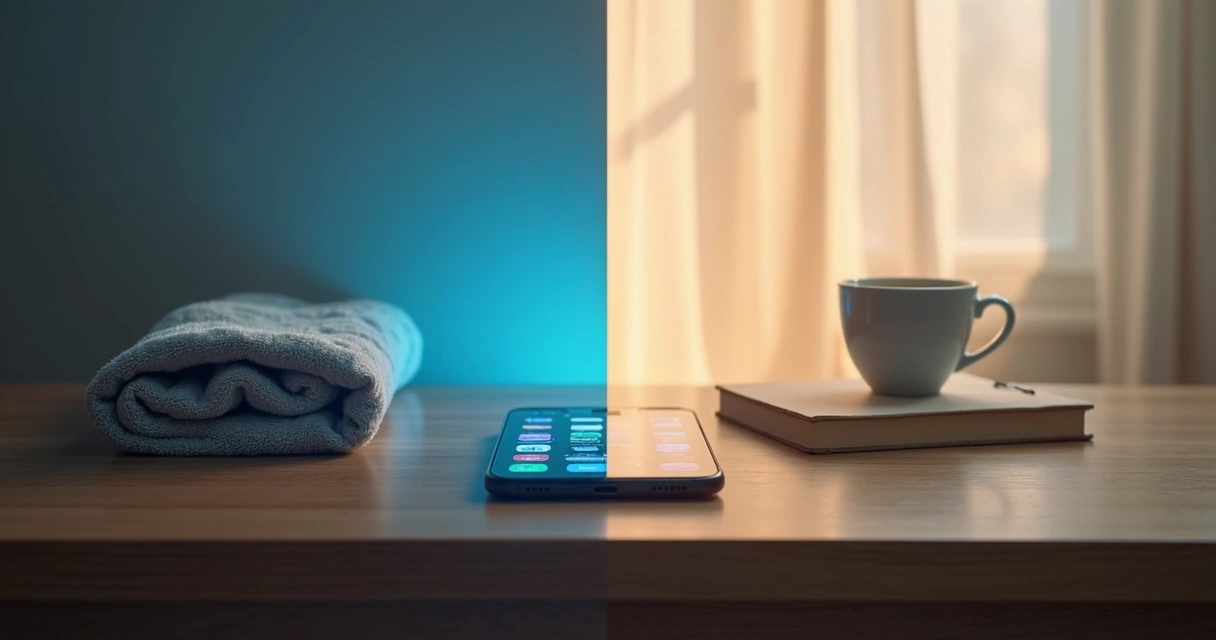
Practices that support true soothing
Many people ask what counts as real self-soothing. We think the best practices are the ones that calm the nervous system without cutting the thread of awareness.
Some examples are:
- Slow breathing with full exhalation
- Warm water on the hands or face
- Gentle movement, such as stretching or walking
- Writing one honest paragraph about what hurts
- Resting in silence for a few minutes without screens
Good self-soothing creates enough inner space for feeling, not enough noise to bury it.
We do not need perfect methods. We need honest ones. Even a small pause of truth can change the whole tone of a day.
Conclusion
Self-soothing and self-distracting both aim at relief, but they do not lead us to the same place. One supports presence. The other often delays it. One helps us settle and stay connected to our inner life. The other helps us step away from it, sometimes for good reason, sometimes out of habit.
We become more mature when we stop asking only, “How do I feel better now?” and start asking, “How do I care for myself without abandoning what I feel?” That question changes everything. It turns relief into responsibility. It turns comfort into awareness.
Frequently asked questions
What is self-soothing?
Self-soothing is the act of calming ourselves while staying aware of our emotions. It may include breathing, rest, warmth, gentle movement, or kind self-talk. The goal is not to erase pain, but to make it more bearable and more workable.
What is self-distracting?
Self-distracting is shifting attention away from discomfort through another activity, thought, or stimulus. It can help for a short time, especially during high stress, but it may also become a way to avoid emotional contact.
How do self-soothing and self-distracting differ?
The main difference is awareness. Self-soothing reduces distress while keeping us connected to what we feel. Self-distracting reduces distress by pulling attention away from the feeling. One supports processing. The other often postpones it.
When should I use self-soothing?
We should use self-soothing when emotions are present and we want to calm down without losing contact with ourselves. It helps after conflict, grief, shame, fear, or overstimulation. It is useful when we need steadiness before reflection or action.
Is self-distracting helpful for stress?
Yes, self-distracting can help with stress when it is brief and intentional. It may lower overload and give the mind a pause. It becomes less helpful when it turns into a constant pattern of escape and keeps us from facing what needs care.